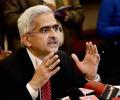
The uncertainty created by the jump in COVID-19 infections and localised lockdowns prompted RBI Governor Shaktikanta Das and other members of the rating setting panel MPC to unanimously vote for status quo in interest rates and an accommodative policy stance to support growth, as per minutes of the meeting released on Thursday. "The need of the hour is to effectively secure the economic recovery underway so that it becomes broad-based and durable," the Governor said during the three-day meeting of the Monetary Policy Committee (MPC) which ended on April 7. The renewed jump in COVID-19 infections in several parts of the country and the associated localised and regional lockdowns add uncertainty to the growth outlook, he observed, as per the minutes of the meeting released by the central bank.

Industrial growth slowed to 3.6 per cent in February, 2011, compared to 15.1 per cent expansion in the year-ago period, dragged down by poor performance of manufacturing and mining sectors.

India on Friday called on the International Monetary Fund (IMF) to reconsider its $1 billion assistance to Pakistan, suggesting that Islamabad could use it for terror funding.

Global trends and trading activity of foreign investors would largely dictate terms in the equity markets this week amid a lack of major domestic triggers, analysts said. Markets may face near-term consolidation due to elevated valuations, they noted. "While the previous week was predominantly shaped by developments in the US Federal Reserve policy, attention will now shift to the Bank of Japan's policy decision on December 19," Santosh Meena, Head of Research, Swastika Investmart Ltd, said.

The growth in world trade is expected to slow down to one per cent in 2023, due to global uncertainties, according to a WTO forecast. The World Trade Organization (WTO) has also projected a growth of 3.5 per cent in global trade this year, as against the April estimate of 3 per cent. World trade is expected to lose momentum in the second half of 2022 and remain subdued in 2023, as multiple shocks weigh on the global economy, the multi-lateral body has said in a statement.

When he didn't respond (Mr Saver has lost count of how many relationship managers he has had in the past few years!), the gentleman landed up at his doorstep and started pleading with him to open fixed deposits with the bank, observes Tamal Bandyopadhyay.

The Reserve Bank on Friday projected retail inflation to be in 5-5.2 per cent range during the first half of the next fiscal year, expecting further softening of vegetables prices in near term. Also, it has lowered the retail inflation forecast for the current January-March quarter of 2020-21 fiscal at 5.2 per cent. The Reserve Bank (RBI) has kept the key policy rate unchanged at 4 per cent, with an accommodative stance, so as to ensure that inflation remains well within the target, Governor Shaktikanta Das said while announcing the last monetary policy of 2020-21.

Reserve Bank will hold its first bi-monthly monetary policy review for 2016-17 on Tuesday.

The Reserve Bank's rate-setting panel will start its 3-day deliberations on Wednesday amid expectations of yet another rate hike of 50 basis points to check high inflation, in line with similar actions taken by other major central banks, including the US Fed. Based on the recommendations of the Monetary Policy Committee (MPC), the RBI had effected 50 basis points increase in repo rate each in June and August after raising the short-term lending rate by 40 basis points in an off-cycle decision in May. The MPC, headed by RBI Governor Shaktikanta Das, is scheduled to meet during September 28-30.

Net NPAs increased to Rs 36,260 crore in the December quarter from Rs 34,843 crore in September and Rs 33,116 crore in December 2023, observes Tamal Bandyopadhyay.

The government, in the forthcoming Budget, could consider levying higher tariffs on imports to check the significant decline in rupee value witnessed in the past few months, said EY Chief Policy Advisor DK Srivastava. The noted economist argued that higher import duties would curb the demand for dollars from importers and help arrest the sliding value of the rupee, which touched a historic low of 86.70 to a dollar on January 13.

'There are lots of low hanging fruits and often no real impediment to plucking them.'

The Reserve Bank of India's (RBI's) caution on inflation, highlighted during the recent monetary policy meeting, may put investors' faith in fast moving consumer goods (FMCG) stocks to test, analysts said. They, however, believe FMCG stocks may ride through this near-term investor anxiety as related companies are, typically, well-equipped to handle inflation due to their pricing power and steady demand for essential goods.
.jpg)
Food and fuel inflation in India have remained high for several years, the paper said, adding to durably reduce the current high inflation, the monetary policy stance needs to remain tight for a considerable length of time.
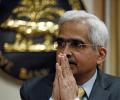
The Reserve Bank on Wednesday increased the benchmark lending rate by 40 basis points (bps) to 4.40 per cent in a bid to contain inflation, which has remained stubbornly above the target zone of 6 per cent for the last three months. The decision follows an unscheduled meeting of the Monetary Policy Committee (MPC), with all six members unanimously voting for a rate hike while maintaining the accommodative stance. While the inflation has remained above the targetted 6 per cent since January, RBI Governor Shaktikanta Das said the inflation print in April is also likely to be high.

The Reserve Bank of India on Wednesday expectedly left interest rates unchanged and maintained an accommodative stance as the economy faces a renewed threat to growth due to the resurgence of coronavirus cases.

Equity benchmark Nifty scaled the psychological milestone of 21,000 in afternoon trade on Friday, and the Sensex touched its all-time intraday high of 69,888.33 after the central bank's decision to keep policy rates unchanged in line with market expectations. The 50-share benchmark index opened on a bullish note, after taking a breather on Thursday, and rose to 21,006.10. As many as 25 stocks were trading in the green, and 24 stocks defied the broader market and were trading in the negative territory.
Exactly a fortnight ahead of the Reserve Bank of India's (RBI's) next monetary policy review, a key market indicator of interest rates - the overnight indexed swap (OIS) - suggests that the central bank may tighten policy by 35 basis points and then refrain from further rate hikes. RBI Deputy Governor Michael Patra recently described the OIS as the primary instrument for hedging interest rate risk in India. The six-member Monetary Policy Committee (MPC) of the RBI will meet on December 5-7.
The Reserve Bank will hold a special meeting of its rate-setting committee on November 3 to prepare a report for the government on why it failed to keep retail inflation below the target of 6 per cent for three consecutive quarters since January. The six-member Monetary Policy Committee (MPC) headed by RBI Governor Shaktikanta Das will prepare the report on reasons for failure to meet the inflation target as well as the remedial measures the central bank is taking to bring down prices in the country. "Under the provisions of Section 45ZN of the Reserve Bank of India (RBI) Act 1934... an additional meeting of the MPC is being scheduled on November 3, 2022," RBI said in a statement on Thursday.

'Limited spillovers' to Asia's third-largest economy, even as world 'perilously close' to recession.

Reserve Bank of India (RBI) on Wednesday upped inflation projection for the current fiscal to 6.7 per cent from 5.7 per cent forecast in April. RBI Governor Shaktikanta Das said the upside risk to inflation persists and the recent spike in tomato prices would fuel food inflation. Also, high global crude oil prices would add to the upside pressure on inflation. The upward revision in inflation projection comes as domestic retail inflation has remained above RBI's comfort level of 6 per cent for four months in a row, mainly due to the Russia-Ukraine war which has impacted the prices of commodities across the globe.
With retail inflation surprising on the upside, the six-member monetary policy committee (MPC) of the Reserve Bank of India (RBI) is expected to increase the repo rate by 35-50 basis points (bps) in the review scheduled for September 28-30. According to economists, the central bank will continue to focus on bringing inflation down even though economic growth has remained sluggish. Data released by the government on Monday showed that the consumer price index (CPI)-based inflation increased by 7 per cent year-on-year (YoY) in August, thus, staying above the upper tolerance limit of the central bank for all the eight months of 2022.

Rating agency Icra on Wednesday said while there is some evidence of the economic recovery becoming broad-based in the third quarter of fiscal 2022, it is yet to attain the durability being sought by the Monetary Policy Committee (MPC) as a precursor to policy transmission. The agency expects the real GDP to expand 6-6.5 per cent year-on-year in the third quarter of FY2022 (+8.4 per cent in Q2 FY2022). It also sees the RBI maintaining the status quo in the upcoming monetary policy review to be held in February.

'Higher interest rates make gold less attractive as it doesn't generate yield.' 'However, with rates set to fall, the tables are turning for gold.'

The economy is projected to clock 7.4 per cent growth.

The wholesale price index (WPI)-based inflation eased in January to 0.27 per cent, mainly due to moderation in prices of food items. WPI inflation was at 0.73 per cent in December 2023. The WPI inflation was in the negative zone from April to October and had turned positive in November at 0.39 per cent.
Reserve Bank Governor Shaktikanta Das on Monday said despite the latest headwinds arising from the Jackson Hole summit leading to extreme volatility, our banking system and financial markets are strong enough to withstand such pressures. Taking the markets by surprise, US Fed chair Jerome Powell had told the annual Jackson Hole summit of central bankers and economists last week that he would have to keep raising federal fund rates to tame inflation, which remains the biggest challenge to the world's largest economy. He also warned of the pains that such monetary policy actions would create on growth and jobs.

'Urjit Patel's appointment is a right decision and in the interest of the country.'
